
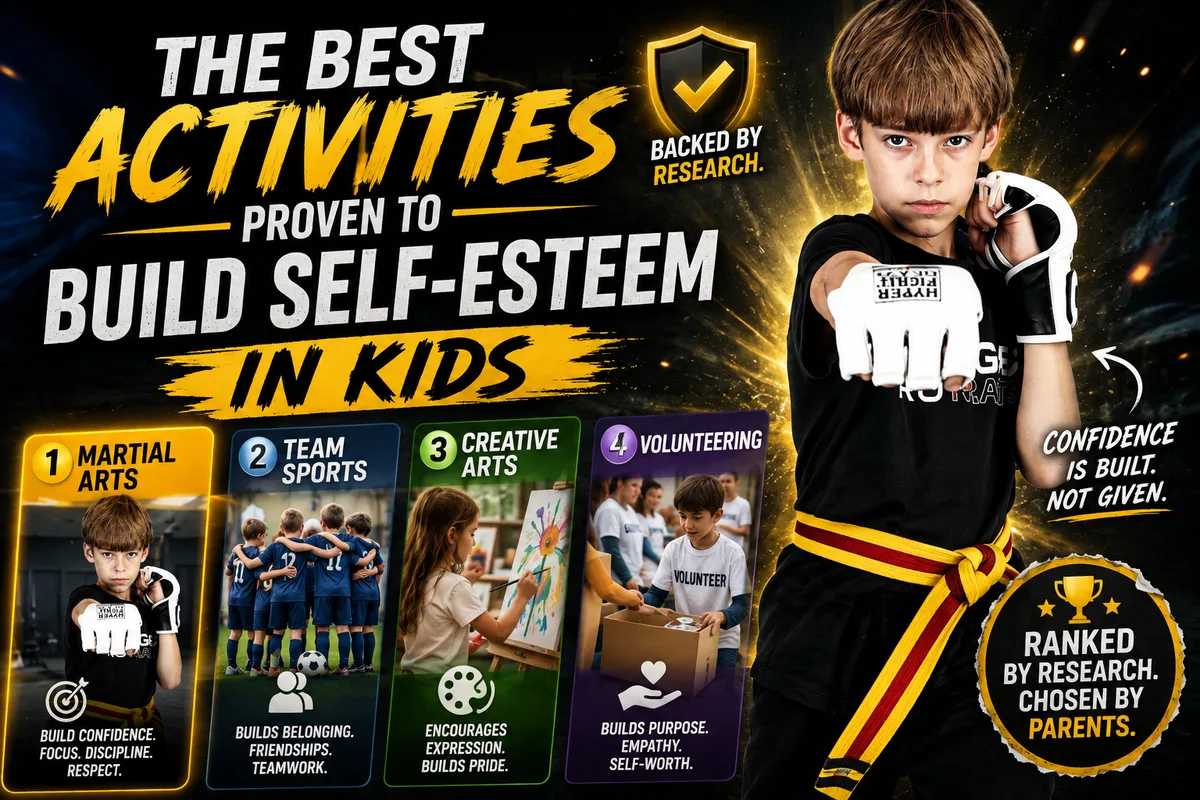
4 Activities Proven to Build Self-Esteem in Kids (Ranked)
You’ve probably already tried the encouragement route.
Telling your child they’re smart. Telling them they’re good at things. Putting the drawing on the fridge. And it helps a little, right up until they walk into a room full of kids and go quiet again.
Here’s the uncomfortable part. Self-esteem doesn’t come from being told. It comes from evidence. Children believe things about themselves based on what they’ve watched themselves do.
So the question isn’t which activity makes your child feel good. It’s which activity gives them proof.
What actually builds self-esteem (the four ingredients)
Before the list, here’s the scoring system. Across the research on youth development, four things show up again and again as the mechanisms behind real, durable confidence:
- Visible mastery. Difficulty the child can see themselves overcome. Not participation. Progress they can point at.
- A trusted adult who notices. Not a parent. Another adult whose good opinion the child has to earn.
- Belonging. A group where they’re known by name and missed when absent.
- Contribution. Being useful to somebody else.
Every activity below delivers at least one of these. The ranking comes down to how many, and how consistently.
1. Martial Arts
Ingredients delivered: all four.
What the research says: Supervised physical activity on its own produces measurable gains in children’s self-concept and self-worth, according to a meta-analysis of 38 studies covering nearly 3,000 children published in PLOS ONE. Martial arts specifically has been studied for improvements in self-control, emotional stability, concentration, and self-esteem, and a 2017 meta-analysis in Aggression and Violent Behavior found consistent reductions in aggression alongside increases in helpful behavior.
Now the honest part. The martial arts research base is smaller and less consistent than the research on organized sport generally. Some studies show clear self-esteem gains. Some show none. Any school that tells you the science is settled is overselling it.
So why does it still rank first?
Why it works: Because of everything the research points at as the mechanism, martial arts is the only activity that packages all of it into a single 45-minute class, twice a week, on a repeating schedule.
- Mastery is built into the format. Belts. Stripes. Tested forms. A child doesn’t have to guess whether they’re improving, and neither do you. The proof is on their waist.
- Progress is individual, but the room is shared. Your child competes against last month’s version of themselves. Nobody loses because a teammate had an off day, and nobody sits the bench.
- Mentorship is structural, not incidental. A meta-analysis of 55 youth mentoring evaluations found the effects depend heavily on relationship quality and on mentors using targeted, skill-based approaches rather than just being friendly. That’s the exact design of a martial arts class.
- Contribution arrives early. Senior students help junior students. Being the one who shows somebody else how is a confidence event most activities never offer a nine year old.
Best for: Children who are shy, children with too much energy, children who’ve been benched in a team sport, and children who need something that follows them off the mat into school.
The limitation: Quality varies wildly. A school that hands out belts on a schedule instead of on merit is selling your child fake evidence, which is worse than none. Ask how a belt is earned before you enroll anywhere.
2. Team Sports
Ingredients delivered: belonging, mastery, sometimes mentorship.
What the research says: This is the strongest evidence base on the list. A 2013 systematic review by Eime and colleagues found improved self-esteem and social interaction to be the two most commonly reported benefits of youth sport participation. A 2026 systematic review of 189 studies updated that picture and found sport consistently associated with higher self-esteem, greater life satisfaction, and lower depression and anxiety symptoms, with team sports showing stronger effects than individual sports, largely because of the social dimension.
Why it works: Belonging does the heavy lifting. Being on a team means being counted on, and being counted on is a powerful thing for a child to feel.
Best for: Socially confident children who are motivated by a group and comfortable with competition.
The limitation: Playing time. In competitive youth leagues, the children who most need confidence are often the ones getting the fewest minutes, and a season on the sideline can teach the opposite lesson from the one you signed up for.
3. Creative Arts
Ingredients delivered: mastery, sometimes belonging.
What the research says: A study of over 2,100 adolescents published in PLOS ONE found visual art participation predicted higher self-efficacy, working through improvements in emotion and cognition. Broader reviews of arts participation link it to self-confidence, self-esteem, relationship building, and a sense of belonging, though researchers consistently note the studies are heterogeneous and hard to compare.
Why it works: Art gives children a domain where the standards are their own. For a child who feels measured all day at school, that’s a genuine relief, and finishing something you made is real proof of capability.
Best for: Introspective children, children who dislike physical competition, and children who need one place in their week where nobody is scoring them.
The limitation: Progress is hard to see. Without a coach naming what improved, a child can spend a year in art and never register that they got better.
4. Volunteering and Service
Ingredients delivered: contribution, sometimes belonging.
What the research says: Youth volunteering has been linked to gains in self-esteem, social skills, and civic engagement across multiple studies. A 2020 study in Children and Youth Services Review found something more specific: among a sample of adolescents, sport participation significantly predicted self-esteem, while volunteering significantly predicted school engagement. Different activity, different lever.
Why it works: Contribution shifts a child’s attention off themselves. Being needed is one of the fastest routes out of self-consciousness there is.
Best for: Older children and teens, especially alongside another activity rather than instead of one.
The limitation: Younger children often don’t yet have the perspective for service to register as meaningful, and volunteering rarely provides sustained skill progression.
The multiplier effect: why this isn’t either/or
Here’s the part most parents don’t expect. Martial arts isn’t a replacement for your child’s sport. It’s an amplifier for it.
Children who train while playing baseball, soccer, dance, or basketball tend to bring three things back to their primary sport:
- Better body control. Balance, footwork, coordination, and the ability to reset after a mistake.
- A different relationship with failure. On the mat, a child misses a technique in front of everyone, gets corrected, and goes again. Twenty times a class. That repetition rewires how they handle a strikeout or a missed shot.
- Confidence that isn’t tied to playing time. When their spot on the team is uncertain, their progress on the mat keeps moving.
We see it constantly with our Henderson students. The child who was hesitant at tryouts comes back a season later and makes the team. Not because they got faster. Because they stopped flinching.
What this looks like at Engage
We’ve been doing this in Henderson since 2012, and the structure is built around exactly the mechanisms above.
- Mastery you can see. Stripes earned, forms tested, belts that mean something because they weren’t handed out on a timeline.
- Coaches who know your child. Small classes, by design. Every instructor is background checked and CPR and First Aid certified.
- Character taught alongside technique. Built into how the class runs, which is why parents tell us the changes show up at home and at school before they show up at a belt test.
- A community, not a customer list. 500+ Henderson families and a 4.9-star rating from local parents.
How to evaluate any program (not just ours)
- How does a child know they’re improving? If the answer is vague, mastery isn’t built in.
- Will one adult here know my child’s name and their specific goals? Mentorship only works if it’s real.
- What happens when my child struggles in front of the group? The answer tells you everything about the culture.
- How soon does my child get to help someone else? Contribution is the ingredient most programs forget.
See it for yourself
The research is useful. Your child in the room is better.
Three for Free is three classes, no commitment and no card required. Here’s what’s included:
- 3 free classes ($100 value)
- Personal welcome session with a coach ($50 value)
- Student skills and goals assessment ($40 value)
- Free Engage t-shirt ($25 value)
- Uniform included, zero obligation
Total value: $215. Yours free. We’ll walk you through the program and pricing in person after that first class, at your pace.
Engage Lifestyle Martial Arts
70 E Horizon Ridge Pkwy #120, Henderson, NV 89002
(702) 518-7727
Serving Henderson, Green Valley, Boulder City, and the Las Vegas Valley.