
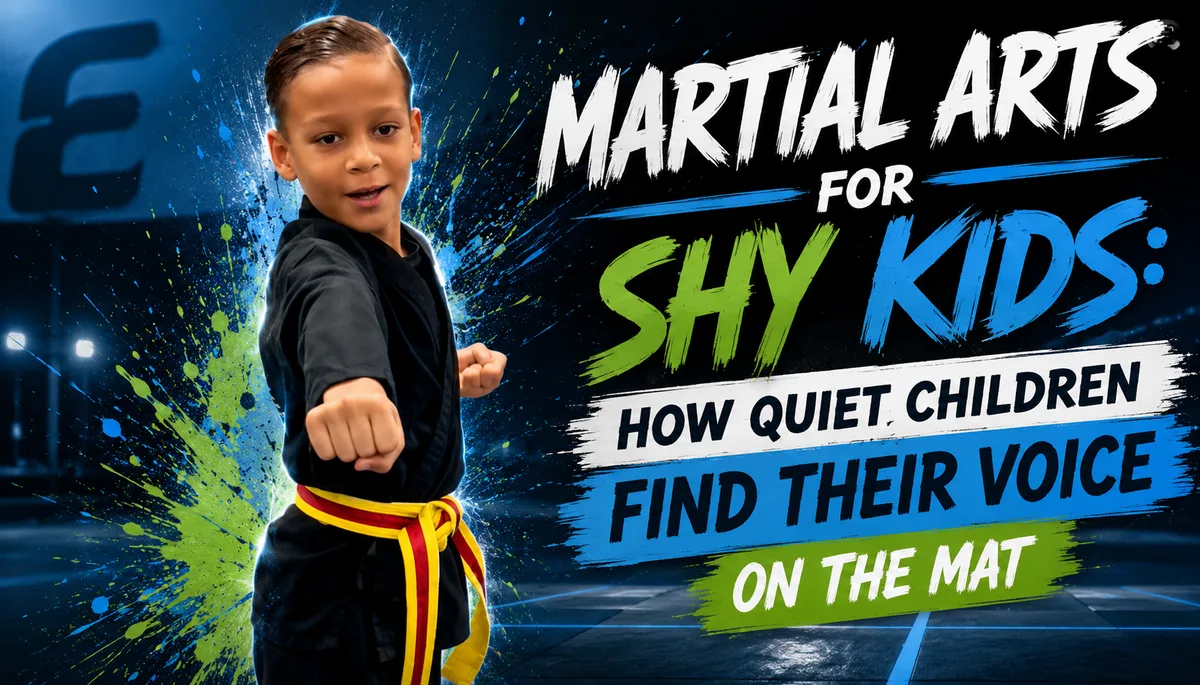
Martial Arts for Shy Kids: How Quiet Children Find Their Voice on the Mat
Your child hides behind your leg at birthday parties.
They know the answer in class and never raise their hand. They love the idea of an activity right up until the moment you pull into the parking lot. Then it’s “I don’t want to go in.”
You’re not looking for a program that will turn them into someone else. You just want them to feel okay walking into a room.
That’s a fair thing to want. And it’s one of the most common reasons Henderson families walk through our doors.
Shy isn’t a problem to fix
Let’s start here, because it matters.
Shyness is not a flaw. It’s a temperament. Quiet children are often the most observant ones in the room, and plenty of them grow into thoughtful, capable adults without ever becoming the loudest person at the table.
The goal was never to make your child extroverted. The goal is to give them the skills to participate when they want to, so their comfort level stops making the decision for them.
That’s a very different thing. And it’s teachable.
Why the mat works when the field doesn’t
A lot of shy children have already tried a team sport. Some of them came home from it feeling smaller than when they left.
Here’s the structural difference.
- There’s no bench. On a team, a hesitant child learns quickly that the safest place is the sideline. In our classes, everyone is on the mat for the entire class. There’s no version of participating less.
- The work is individual, but the room is shared. Your child is measured against their own last attempt, not against the child next to them. No one loses because they were nervous.
- The structure is predictable. Same greeting. Same warmup. Same order. For a child whose anxiety runs on “what happens next,” a class that follows the same shape every time removes the part that was scary.
- The social steps are small and named. A shy child doesn’t need to “make friends.” They need to say their name out loud to one person. Then hold a pad for that person. Then partner with them again next week. We break social confidence into reps, the same way we break down a kick.
- The class is small enough to be seen in. Coaches know your child’s name from day one. A quiet child can’t disappear in a crowd here, which is exactly the point.
How socializing actually happens in our program
Nothing about this is a group discussion or a feelings circle. It’s built into the class itself.
- Greeting on entry. Every student is greeted by name and expected to return it. That’s a hundred small reps of eye contact over a few months.
- Partner work. Children hold targets for each other, count for each other, and reset drills together. Cooperation is the mechanism, not the lesson topic.
- Line order and turn-taking. Waiting, watching, then performing in front of the group. Low stakes, high frequency.
- Verbal responses. “Yes sir.” “Yes ma’am.” Loud enough for the coach to hear. For some children, that first audible answer is the whole month’s win.
- Recovery in public. Children miss a technique in front of everyone, get corrected, and go again. Learning that a mistake in front of people is survivable is the single biggest unlock for a shy child.
- Peer helping. Older students help younger ones. Being useful to someone else is the easiest social door a quiet child ever walks through.
One Henderson parent put it plainly in her review: the coaches gave her daughter guidance that was gentle but firm, and she grew in skill and confidence at the same time. Another parent told us her son became more confident and outgoing in the best possible way.
What to expect by age
Social development doesn’t move at one speed. Here’s what growth realistically looks like at each stage, and what we’re actually coaching toward.
Ages 5 to 7: participation before friendship
At this age, children play near each other more than with each other. That’s normal. So we don’t ask for friendship. We ask for presence.
What we’re building:
- Walking onto the mat without a parent escort
- Saying their own name out loud so the group can hear it
- Making eye contact with a coach for a full sentence
- High-fiving or fist-bumping a partner
- Standing in line and waiting their turn without needing a reminder
What progress looks like at home: your child talks about a coach by name. They tell you one thing that happened in class instead of “it was fine.”
A win at this age is a one-word answer becoming a two-word answer.
Ages 7 to 9: from being noticed to being okay with it
This is when children start tracking who’s watching. Self-consciousness arrives, and for a shy child it can arrive hard. The work here is about tolerating attention, not avoiding it.
What we’re building:
- Choosing a partner instead of waiting to be chosen
- Asking a coach a question without a parent prompting them
- Encouraging a partner out loud (“nice kick,” “you got it”)
- Demonstrating a technique in front of the class
- Getting corrected in front of peers and staying in it instead of shutting down
What progress looks like at home: they volunteer at school. They handle a change in plans without spiraling. Teachers mention it before you do.
A win at this age is a child who messes up in front of everyone and tries it again anyway.
Ages 10 to 12: from participating to leading
Now the social stakes are about status. Children this age would rather do nothing than do something and look foolish. Which is exactly why we hand them responsibility.
What we’re building:
- Leading a warmup or counting reps for the group
- Helping a younger student fix their stance or tie their belt
- Introducing themselves to a new student on their first day
- Giving feedback to a peer, and taking it without getting defensive
- Noticing the child standing alone and going over
What progress looks like at home: they speak up for themselves with adults. They handle a friendship problem without needing you to solve it.
A win at this age is your child becoming the person who makes a new child feel welcome.
The realistic timeline
Not a transformation story. A sequence.
- Week 1. They walk in nervous. They leave smiling. First class, first uniform, first coach who already knows their name.
- Month 1. The small stuff shifts. Eye contact. Answering out loud. Getting out of the car without the negotiation.
- Month 3. Real technique, and real ease in the room. They have a coach they’d choose and a partner they look for.
- Year 1 and beyond. Quiet confidence. Not loud, not showy. Just a child who can walk into a room and be fine.
Some children move faster. Some take longer, and that’s genuinely okay. We coach the child in front of us, at the pace they’re actually on.
What you can do at home
- Don’t apologize for them. When an adult asks your child a question, give them the extra three seconds before you answer for them.
- Praise the attempt, not the outcome. “You asked the coach yourself” lands harder than “you did great.”
- Skip the pep talk in the car. Pressure before class raises the stakes. Normal conversation lowers them.
- Let the first class be low expectations. Watching from the edge for ten minutes is still a first class.
Come see it for yourself
The honest test isn’t a blog post. It’s your child in the room.
Three for Free is exactly what it sounds like. Three classes, class T-Shirt, coaching included, no payment and no commitment. We cover the program details and pricing with you in person after that first class, at your pace.
$0 today. No card required.
Engage Lifestyle Martial Arts
70 E Horizon Ridge Pkwy #120, Henderson, NV 89002
(702) 518-7727
Rated 4.9 stars by Henderson parents. Serving Henderson, Green Valley, Boulder City, and the Las Vegas Valley since 2012.